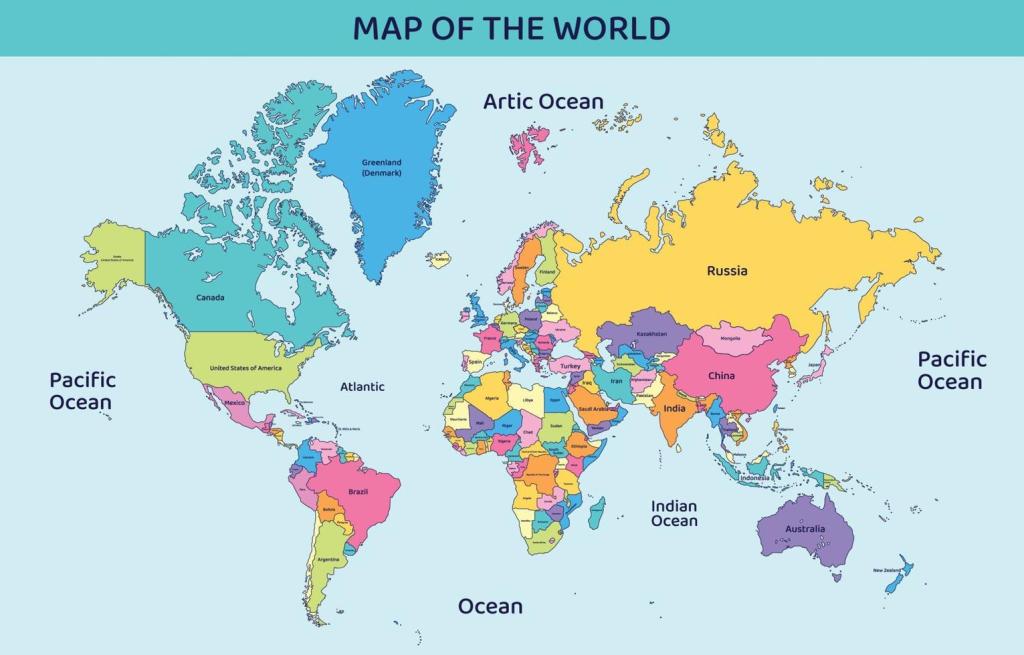
The geopolitical world map (source)
Introduction
An essay to discuss a very turbulent time in history in the shadow of a Third World War, with economic and debt crises to intensify over 2026 and 2027 as the PetroDollar faces its latest threat in the face of the latest regional war in the Middle East, and the role Bitcoin is already starting to play in the monetary geopolitics of the world for the next decade.
Starting Point – A History Lesson to Set the Stage
The one foundational element to understanding history is that it never stays still, and that the history of any nation is a series of civilisational peaks and troughs.
Foundational civilisations relied on the development of languages, laws and accounting for governance and taxation, and were initially land based and a slow evolution over thousands of years, from Sumeria, to Egypt, Babylon, and Phoenicia, the pre-monetary age comes to an end with the establishment of the Persian Achaemenid Empire (Iran today, interesting enough!!) conquering all these previous civilisations, by Cyrus the Great in the mid Sixth Century BC. The evolution to a monetary empire reflects the shift of empires from land to sea, which requires an independent medium of exchange for foreign trade.
The Persians are the first to establish a monetary empire that came to encompass half of the world’s population at the turn of the Fifth Century, and gold and silver coinage weaponised their ability to centralise and administrate, while also speeding up the turnover of monetary civilisations from millennia to centuries. For the next thousand years monetary empires dominate, from the Athenians, to the Macedonians to the Romans, that through the Denarius rules Europe and the Middle East for over five centuries.
From the Fall of Rome around 500 AD, Western Europe recedes geopolitically to the Dark Ages of political decentralisation and a land based feudal order dependent upon ledgers and accounting, while monetary empiricism is adopted in the East by the new religion of Islam, from the Eighth Century the Dinar, muslim money with its name deriving from Rome’s Denarius, unites the Middle East and spreads outwards to the Mediterranean, pressuring the remnants of the Roman Empire in the East, the Greek Byzantine Empire.
The next centuries witness the attempts of the Islamic world to conquer the Christian world, including North Africa and the Iberian Peninsula, and Europe’s defence in aid of the Byzantines through the Four Crusades between the Twelfth and Fourteen Centuries, to remove muslim influence from the Christian world. While there is success in expelling the muslim from the Iberian Peninsula, the Crusades fail in the Middle East, culminating in the Fifteenth Century with the Ottoman Empire’s conquer of Constaninople, an the end of the Byzantine Empire.
The Age of Sail begins in the Catholic countries following the reconquering of the Iberian Peninsula, Portugal then Spain establish new trading colonies in Africa and Asia, in addition to discovering the New World on the American continent. A worldwide maritime empire necessitates the return of monetary economics through gold and silver coins.
The Reformation in Northern Europe from the Sixteenth Century leads the competition of new Protestant countries, especially in Holland, and the supremacy of the Dutch Empire during the Seventeenth Century. The Dutch evolve a monetary system based on central banking, with the Amsterdam Wisselbank from 1609, which is in effect the world’s first central bank.
Over the Eighteenth Century Britain and France overpower the Dutch as the pre-eminent empire, with Britain rising to the world’s most powerful navy in the wake of its victories in the Seven Years War that end in 1763. British supremacy over France is confirmed at the Battle of Waterloo in 1815, at the end of twelve long costly and bloody years of the Napoleonic Wars.
Britain has already adopted the concept of central banking following the Glorious Revolution of 1688, replacing a semi Catholic Scotsman (James II) with a Protestant Dutchman (William III), only six years later the Bank of England is established in 1694, the world’s second oldest central bank.
In addition to financing the world’s preeminent navy, the Bank of England plays a key role in the birth and flourishing of the Industrial Revolution transforming Britain into the workshop of the world, and its worldwide colonies as ample markets for buying its exports, Britain comes to rule the world though1 Mercantilism and the Industrial Revolution between 1750 and 1850.
At its apex of global power, Britain repears the pattern of Portugal, Spain and Holland, by moving away from an economy based on exports to an economy based on imports, which is a by-product of claiming world reserve currency status and the requirement to export your money to the rest of the world while eliminating tariffs on foreign trade. In Britain, this happens under Prime Minister Robert Peel and the father of the modern British State, with the revoking of the Corn Laws while establishing monetary laws centralising the powers of the Bank of England, Britain embraces liberalism that leads to the split of the Conservative Party, and the destruction of Peel’s career.
Based upon Triffin’s Dilemma, the rise of Britain to the world’s financer is the fall of its industry by eporting the forces of mercantilism to the rest of the West, especially the United States and Germany, slowly erode British supremacy. Having been double the size of the American economy in 1850, by 1900 Britain had receded to half the size of America and the same size as the German economy, fueling an increasing emergency within Britain and the rest of Europe, inevitably leading to the First World War.
The First World War boils down to a genocidal deathmatch betwwen the established power of the British Empire and the establishing power of the German Empire, dragging the rest of the world into the destruction. Indeed, the fear of a German ruled Europe forces Britain to lobby its former colonies, that since the 1776 Declaration of Independence had become the world’s richest country, the price paid by Britain for its defeat of Germany was establishing its military dependence on the United States to win wars, starting the clock on the American Empire. In addition to the demolition of the German Empire, the Great War brings an end to the Austro-Hungarian Empire dividng middle Europe, the Russian Empire shattering Eastern Europe and Eurasia birthing the Union of Soviet Socialist Republics, and the six century old Power of the Ottoman Empire collapses destabilising the Middle East, via the Sykes-Picot agreement spheres of French and British influence in the region would fill the void.
After the War, the attemps to rebuild a Democratic Europe under siege by the international Communist movement, drives the reaction of nationalist, anti-communist parties, first in Italy ynder Mussolini, then in Germany under Hitler, and in Spain under Franco. The indusrtial resurrection of Germany, laced with tensions and revenge deriving directly from the First World War builds towards the Second World War, intensifying through the Great Depression of the 1930’s and beggar thy neighbour economics.
The Second World War like the first, begins as a war between Germany and its continental neighbours in France on the Western front and the Soviet Uniom on the Eastern front. In the early days a German victory looks likely, before Britain’s entry into its second war, and once again dragging the United States into its second world war, and due to its industrial power and wealth, guarantees victory for the Allies and the destruction of the Third Reich, and German influence within the European continent.
World War Two and the Imperial Transition

The biggest monetary restructuring in a Century (source)
It could easily be argued that the United States was already the world superpower by the end of the Great War, even though it did not yet possess world reserve currency status or Britain’n worldwide military infrastructure, and full supremacy would take until the last year of the Greater War. The world’s financial centre had shifted gradually over the Roaring Twenties from the City of London to New York, and from US entry into the war it forced Britain to sign over its worldwide military infrastructure through Lend Lease Laws between 1941 and 1945, and the US Navy became the world’s most powerful in the wake of the naval battle of Midway in the Pacific Ocean in June 1942.
Over July 1944 the Bretton Woods Standard was established, and the official transition of world reserve currency status to the United States in the form of a Gold Exchange Standard, allowing redemption of foreign currencies for dollars backed by the gold in the US Treasury. In effect, the agreement repeats the historical pattern where the world superpower is forced to transform its economy based on national exports or mercantilism, towards importing the industrial goods of the rest of the world and free trade. And with that, the clock starts ticking on the culture struggle between West and East in the Cold War.
The Suez Crisis – The End of European Influence in the Middle East
The Suez Canal Crisis happens only a decade after the war, and is an interesting preview of the current situation that the United States is replaying today. The spark to ignite the emergency was the decision of Egypt to nationalise the canal under British ownership, reflecting the recent decision of Iran to nationalise the Strait of Hormuz. And like the United States used its air power to bomb Iran to break the Hormuz blockade, so did Britain and France use their airpower to bomb Egypt to break the Suez blockade, to no avail. Indeed it could be argued that only army power and boots on the ground could have lifted the blockade in Suez as in the case of the Hormuz, in the case of Suez Britain and France did not have the international power to accomplish, and in one of the few agreements between the United States and Soviet Union during the Cold War, both came together as Permanent Members on the Security Council of the United Nations to veto British and French intervention, bringing to an end their influence in the Middle Eas and introducing American influence over the Middle East.
The Seventies – The Nixon Shock and the End of the Gold Standard, The Beginning of the Oil Standard and the PetroDollar

Nixon and Kissinger in the Middle East (source)
Despite the best efforts of the United States to restructure around the Dollar with the Bretton Woods Standard, Triffin’s Dilemma that faces world reserve currency status had struck once more, benefitting Europe after the war by buying up its industrial exports, while on the other side of the ledger US gold reserves had halved from 16,000 tonnes at the end of the war to 8,000 by the end of the Sixties. In between, the US had further exploited its exorbitant privilege in printing dollars out of thin air to finance the expansion of the welfare state domestically and expansion of foreign wars against the Communist bogeyman in the East. With European fears that the US Dollar would depreciate further and already slowly emptying the treasury of its gold for years, by the early Seventies to stem the flow Richard Nixon decided to close the Gold Window, in the decade that saw the Great Inflation.
With the United States requiring a new anchor for the Dollar, in the Seventies it took advantage of its new found influence in the Middle East to transition to the Oil Standard. Henry Kissinger met primarily with the leadership of Saudi Arabia to agree to sell their oil for dollars, and recycle those dollars into buying treasuries and US national debt. In exchange, the US would engineer a precipitous rise in the price of oil impoverishing Western oil consumers while supporting the value of the oil standard, making middle eastern oil exporters obscenely rich and increasing their influence over US politics. Furthermore, the US would ensure the continuance of this new system with a security guarantee in the form of its air force, navy and army to protect its partners from the forces of any competitors, and every war in the Middle East since has been to protect this arrangement, at the cost of the blood and suffering of countries such as Iraq, Afghanistan, Libya and Syria.
In effect, this is is the near six decade order that is under threat today by the latest war in the Miiddle East, the war in Iran.
The History of the United States and Iran

Between two Western Empires – The Geopolitical Great Game of the Nineteenth Century (source)
It is important I believe, to provide some historical context to back the current war between the United States and Iran. Even though the historical peak of Iran was Persia as already discussed and Iran had been a cemetery for many imperial pretenders over the centuries, with the extension of Western power East over the Eighteenth and Nineteenth Centuries, Iran became a geopolitical frontier in the Great Game between British and Russian Empires. In the Twentieth Century, the rivalry between Britain and the Soviet Union brought the two together for the Anglo-Soviet invasion of the Imperial State of Iran as a neutral member in the Second World War, in August 1941.
After the War, under the Prime Ministership of Mohammad Mosaddegh Iran campaigned for its sovereignty by nationalising the oil industry under British ownership, and to sabotage this the secret services in the form of the CIA and MI6 conspired to depose Mossadegh and democracy, for the rule of the Shah family monarchy, and their subordination to Anglo-American influence. After a quarter century of authoritarian Shah rule, ordinary Iranians had been radicalised into revolution, and in the wake of protests and rebellion of roughly ten per cent of the population came the Islamic Revolution, a public referendum of nearly a hundred percent for establishing the Islamic Republic, enthroning Ayatollah Khomeini as Supreme Leader.
.The Western reaction to this republican chutzpah was spending the next eight years between 1980 and 1988 encouraging, financing and weaponising the adventures of Saddam Hussein in the Iran-Iraq War, including the widespread use of chemical weapons against Iranians, in a war that killed half a million.
Since coming to peace at the end of Eighties, it has been a Western policy to starve Iran into submission by economic sanctions, prohibiting the use of Dollars to trade, and four decades of impoverishment for Iranian citizens squeezed between an authoritarian Islamic leadership, and the severe economic penalties of the United States. America hoped the impoverishment would radicalise the public to overthrow and remove the leadership, but in reality the sanctions have bled the middle class only empowering the leadership, despite periodic protests. This is not to say that the Islamic Republic is especially popular among common Iranians, but that they remember past political interference from the West in their history, and therefore more accomodating toward the current regime than what would come under Western puppet rule.
The West has taken Iran lightly until recently, believing their economic influence over the rest of the Middle East would gradually undermine the Republic, and bring the country to its knees.
The Military Strategy of the United States
The military strategy of the US is predictable, and hasn’t changed much during its hisory. The historical tactic of the US is “shock and awe”, that is bombing enemy navies, air forces, air defences, and infrastructure, along with Israel’s shock and awe tactic of assassinating the leadership of the IRGC, that would be enough to collapse the regime bringing Iran to its knees, and force its submission.
Six months into the war and these tactics have not worked, as America gets sucked deeper into another forever war it is bound to lose. As the history of American invasions highlight, they do not perform well in long term wars as was discovered in Korea, Vietnam, Iraq and Afghanistan. The longer the war goes on, the more it will cost in increasingly scarce weaponry, a cost of living crisis in America and its Western and Asian allies alongside an intensifying worldwide depression, the more goodwill of the rest of the world towards the latest adventure in the Middle East will bleed out.
The Military Strategy of Iran
On the other side Iran’s strategy is defensive, using its hostile territory against a ground invasion by the United States, and depending on relatively cheap to produce missiles and drones compared to the enemy. Iran has not much of an air force or a navy, but it has a million man army in addition to the Revolutionary Guard, and mountaneous terrain of a country roughly the area of Western Europe, around 90 million inhabitants, and bordering on the inhospitable Iraqi desert. Any boots on the ground invasion by the United States would require at least hundreds of thousands of soldiers.

The all important geopolitical map of the Middle East (source)
In addition to the exorbitant costs put upon the United States, Iran decided to punish the surrounding Gulf Countries, painting them into a corner incentivising the expulsion of the United States out of the Middle East. As already discussed, the PetroDollar standard was based upon the agreements struck between the United States and Saudi Arabia in the early Seventies, and today includes the UAE, Kuwait, Oman, Qatar, and Bahrain, forming the Gulf Cooperation Council (GCC). Surrounded by enemies loyal to the United States, following the initial attacks on the 28th February, Iran used its missiles and drones to attack targets in all the GCC countries, destroying tens of military bases the US had in the Middle East, while also targetting oil and gas infrastructure that is slowly destroying these countries. Furthermore, Iran has warned the Gulf countries that any further attacks by the US or Israel will lead to the targetting of the electrical grid and desalination plants of the Gulf, threatening to bring to an end to life for all purposes in these countries on the parched Arabian Peninsula. The cost Iran has decided to put upon the Gulf Countries for their Western treason (in Iran’s eyes) is to threaten their future, and coerce them into expelling US military and monetary infrastructure out of the Middle East.
Using Game Theory to Predict the Future of the War
The strategies discussed above raise a number of thought provoking and deep questions over the motives of the players of the game with deadly serious implications.
With US hopes for a short attacking war over, they are dependent upon their sanctions and blockade of the Hormuz Strait forcing Iran to its knees and to the table to discuss the terms of their submission, which considering their history of fighting to the death, especially their defensive eight year war against Saddam Hussein’s Iraq in the Eighties, seems unlikely to me at least. Without a short term Iranian submission, a long term war will waste more ever dwindling American goodwill with the rest of the world, sucking it deeper into a boots on the ground campaign threatening the repeat of the disasters of Vietnam, Iraq and Afghanistan, the first American military draft in five decades, along with political crises and domestic cost of living crises. The cheapest way out of the quagmire Donald Trump has waded into, is yielding to Iranian demands in order to avoid the global recession that oil shortages will create this year and next, but it must be understood this would a major strategic defeat changing the face of world geopolitics, in effect kicking the United States out of the Middle East. Such a humiliation would confirm the end of the United States as the unipolar world power, the end of its influence over the oil and gas centre in the Middle East, and a disastrous legacy for the presidency of Donald Trump.
Reflecting the fall of the United States, is the rise of Iran from regional backwater to supremacy in the Region. Erstwhile weakened under decades of Western sanctions and surrounded by allies hosting military bases and enduring the first attack, since its counter-attack Iran has dragged the US into a costly forever war, and attacked all the Gulf countries to encourage divisions amongst the allies under the threat of their long term survival. The longer Iran can continue to squeeze its geopolitical enemies, the stronger its influence in the Middle East becomes, despite the punishing short term costs.
The Gulf Cooperation Council is now in a bind! Having taken for granted that US security guarantees would defend them against Iranian aggression in the region, and since the Seventies bought fully into the PetroDollar and an important secondary centre for spreading Dollars to the rest of the world, with the Iranian blockade of the Hormuz and missile and drone attacks on oil and gas infrastructure, suddenly enough the energy and tourism economies of the Gulf are hanging in the balance. With exports of oil, gas, fertiliser and helium severely curtailed if not on complete stop, Dollars are no longer flowing into the Gulf threatening these countries and the health of the Dollar at the same time. Additionally, the Gulf’s tourism industry as a haven for British and European exiles fleeing over-taxation and over-regulation of their native governments, that has contributed local economic growth and wealth, is now at stake. The Iran attacks have huge implications for the Gulf’s future economic model, especially as a Dollar and US centre in the Middle East looking out towards Asia. In effect Iran has forced the Gulf countries to make a decision: continue as American vassals and further targets for Iran’s devastating offensive weapons, or come to peace with Iran (and closer to the East) by expelling the United States out of the region. The Gulf countries are divided and to remain united, despite the revengeful desires of Saudi Arabia and UAE for Iran’s war upon them, union will be their strength as they decide whether the West or East is their future.
Maybe Israel should be higher or even at the top of this list, considering it was probably its military “intelligence” and the sweet whispers of Benyamin Netanyahu that persuaded the Donald into the war to begin with, due to the power and money of the Israel Lobby within the United States to influence its politics so heavily, and its foreign policy and support towards the Israeli project. Indeed, since its modern inception Israel has been a Western colony in the Middle East, from the wellspring of jewish immigration from the Russian Empire and Eastern Europe at the end of the Nineteenth Century, the British Mandate over Palestine following the Great War with further European emigration in the catastrophe of the first half of the Twentieth Century, ending with the creation of the State of Israel by the United Nations in 1948. After Britain’s pullout and in the wake of its humiliation in the Suez Emergency, the United States has shouldered the burden of financing ar arming Israel up to today. The war with Iran has highlighted to the world, but especially within the United States, the incestous relationship with Israel, heightening tensions and the relationship between the two countries. Indeed, I do not feel it controversial to argue that the modern Israel is completely dependent upon American dollars and arms for its future, and therefore the deterioration of America’s power and influence since the start of the war, reflects the deterioration of Israel’s geopolitical influence in the region, leaving it isolated surrounded by rising regional enemies, such as Iran and Turkey. With a population of only ten million up against enemies with tens of millions, Israel’s weakness and dependence on the West is obvious. Israel is the big loser of this war in my opinion, as the balance of power shifts towards the East.
Even though I would consider Russia and China to be more peripheral players in the war up until now, China has close trade connections and Russia has close trade and military ties with Iran, so it is worth discussing their situation in the mess. It can be argued that Russia as one of the world’s largest exporters of oil, gas and fertiliser has been the biggest beneficiary of the energy crisis so far, with higher prices and expanding relationships with countries begging for cheap and reliable energy, and in effect paying for the war in Ukraine for this year at least. China as an energy importer derives much of its oil, gas and fertiliser through the Strait of Hormuz and is one of Iran’s best customers, but on the other hand the Iran war has benefitted Russia and China by distracting the United States from the war in Ukraine in the case of Russia, and delayed the Pivot to Asia and further geopolitical meddling in the foreign policy of South Korea, Japan and Taiwan in the case of China. Despite this, it could also be argued that Russia and China are two countries that desire peace in general, to boost their economies dependent upon exports and running trade surpluses with the rest of the world. Behind the curtain, and through the mediation of Pakistan, the two Great Powers and the reason we live today in a multipolar world, are working towards peace in the Middle East because of their self interest in new influence and opportunities that will arise as the power and influence of the United States weakens over the region.
Further on the margins, there are many Eurasian countries also working in their self interest, if not central players in the game, including Turkey, Egypt, Pakistan and India.
Short Term Implications of the Iran War For the Rest of the World
Twenty percent of the world’s oil runs through the Strait of Hormuz that has dried up, rising to a third if the war expands and Iran’s allies in Yemen, the Houthi’s, blockade the Bab-El Mandeb Strait that runs to the Red Sea.
The fuel crisis is already visible in Australia, Asia and Europe, and the longer the war drags on, the higher oil and fuel prices will soar. As fuel such as diesel is one of the prime input costs for food and transportation of goods, it should be obvious that food and transportation costs are going to rise for the rest of this year at least. Even if the war comes to an end tomorrow, supply chains in oil and distillates will take months if not years to reset, driving further poverty and economic contractions for the near future.
Even more important, the Gulf Countries produced around a quarter of the world’s chemical fertiliser, which is increasingly scarce and more expensive, with massive implications for the Northern Hemisphere’s planting season, and this year’s harvest. Food shortages are going to be a reality by the end of the year, especially in the world’s poorest countries such as the African continent.
Long Term Implications of the Iran War
The long term implications have already been discussed to some extent, this is a historical turning point for the Middle Eastern region as a whole, and I argue the balance of power has shifted from the West toward the East. Iran has demonstrated to the world by adopting drone and missile technology for defensive purposes, that middle powers now have the means to fight back against far larger military powers, and an advantage shift towards the defender and against the attacker. Furthermore, United States attacks were partly based upon opposition to Iran’s nuclear ambitions, have ironically persuaded Iran that it needs nuclear weapons more than ever as a threat against further attacks! The one person holding back Iran’s nuclear program was the Supreme Leader Ayatollah Khamenei that had placed a legal prohibition or Fatwa on the development of nuclear arms within Iran, since his assassination the fatwa is also likely severed, and I do now expect Iran to start producing nuclear weapons going forward as a deterrent against further offensives in the future. Iran already has close historic relations with North Korea and more recently with Pakistan, both of which are nuclear powers, and common security agreements between Iran, Turkey, Egypt and Pakistan presages the development of a native Middle Eastern security architrcture that is independent from the West and the East, leading to a third sphere of geopolitical influence. The ultimate outcome of the disastrous attacks unleashed by the United States on Iran, will be to convince the middle powers of the world to develop national nuclear weapons programs, and so the danger of nuclear prliferation and wars will increase with decentralisatiom unfortunately.
The long term implications for the global financial system, will be discussed next.
Economic Weakness and Prospects for Worldwide Recession From the War
A major there of my blogs has been the EuroDollar monetary crisis since 2008, and the worldwide destruction it has created. A persistent monetary depression has been playing out for the last two decades, wherein shortages of Dollars worldwide has impinged upon the ability of banks to borrow them to create credit, stifling economic growth within the United States, but especially outside the US in the secondary historical centres of the EuroDollar, such as Britain (London), Europe and Japan. As economic growth has suffered so has the living standard of citizens, which has in my opinion (and many others) contributed heavily to the rise of Populism, seen most glaringly a decade ago in the consequential year of 2016 with the double shock of Brexit and first coming of the Donald.
In effect when the decentralised EuroDollar system, itself a reflection of centralised Dollar reserves of the US was growing, then the rest of the world’s economies were growing and reflecting the increasing trend of globalisation, inter-connection and co-dependence that the world saw from the early Seventies and the establishment of the PetroDollar until August 2007. Since the worldwide Great Financial Crisis of 2008 everything has inverted, the trend of globalisation has given way to de-globalisation, dis-connection and de-dependence, which is an inflationary and costly process, and creates divisions and wars between countries, in a bear cycle for international cooperation and bull cycle for nationalism and national sovereignty. Another reflection of the de-globalisation trend of the last decade, is concurrent with the transition from unipolarity (the United States) to multipolarity (the rise of China, Russia and Iran). The last two decades of EuroDollar contraction can even be connected to the trend of national depopulation playing out over the world at present (outside of Africa), as a confluence of national debt, debasement of national currencies, and cost of living crises make children and raising families uneconomic and unattractive to native populations.
The all-important point to be made here is that our worldwide monetary system is broken, the international EuroDollar has been stagnating along with national living standards, depopulation and scarcity of children, is set to continue for the short term future at least, the wealth of nations will continue to deteriorate while domestic political tensions will increase. The collapse of our monetary system is more of a multiyear process than an overnight event, that will take the next decade, including further recessions and financial crises.
While many economists have called the post 2008 period the Silent Depression or the Greater Depression, in other words the world has been in depression for longer than the Great Depression of the Thirties, governments, the media, and economic statistic agencies have corrupted traditional measures of economic growth to hide the depression, and governments over the last twenty years have created gargantuan public sector debt to paper over all the cracks of its private sector, to prop up the financial sector nationalised in 2008 to avoid its collapse.
As part of the nationalisation, the Bank of England increased its influence over the financial system by taking the debts of the banks on its balance sheet, printing a flood of bank reserves to buy government debt (bonds) keeping its interest (yield) costs lower, along with driving short term interest rates to zero to support debtors paying back their debts, at the expense of stealing interest from savers and wealth already created. These central bank operations not only in Britain but over the world nearly two decades ago, continued the ability of national governments to borrow cheaply and continue the growth of the public sector at the expense of the health of the private sector, to over-tax and over-regulate and stifle economic growth exploding the size of the welfare state, creating further dependence on the government. The zenith was reached in 2020 with the Covid madness, when the world was locked down for a flu for nearly two years, forcing the bailout of the private sector and a horrifying increase in the borrowing and national debt over the world, leading to the short-circuiting of the low inflation and low interest rate cycle.
Sometime in late 2020 during the dislocation of global energy and transport supply chains, the trend began that is now nearly five years old, of increasing interest rates and cost of living inflation. The decade of cheap debt issuance since 2008 had enlaved the world to more and more borrowing for less and less interest, and much of the poverty we have seen since is due to higher borrowing and interest costs, on personal loans, mortgages, and the national debt. Interest costs have siphoned disposable income away from leisure and hospitality contracting the leisure and hospitality industries, and small local businesses have suffered enormously from the dislocation. Additionally, the halfwitted energy policies of Britain and Europe especially, have led to amomg the world’s most expensive fuel and electricity, and the primary input costs into agriculture, industry and transportation, contributing much to the cost of living crisis suffered since the turn of the Twenties, and it will take many years to develop and build cheap energy once again, meaning the costs of energy, food and life will continue rising for the next decade, driving domestic tensions and further Populism.
As hopeless as things may look for Britain’s private sector that pay the taxes, the condition of the public sector that live off the taxes is so much worse! In the process of nationalising the economy since 2008 the government has grown to gargantuan proportions, nearing towards spending half of Britain’s GDP today. To finance the spending tax rates are at their highest since the Second World War and nearing forty percent of life, stifling the private sector and especially small local businesses since Covid, and it is fair to ask where all our taxes and inflationary debasement of our national currency is going to finance? This is where the hopeless situation of the British government and overseas becomes apparent, despite all the taxes collected it is nowhere close to financing our government, enslaving it to international capital and the “bond vigilantes”, that in turn demand fair interest rates to reflect the weaknesses of their debtor. All this means that higher interest rate yields on the national debt swallows more of our taxes, while the standard of our public services, from health to defence, from education to the police and local authorities, deteriorates. The vicious circle should become clear, higher interest rates are going to drive higher taxes and worse local services, businesses closing leading to less tax payers and more receiving taxes on the dole, as debts continue to increase until national bankruptcy.
The above at some point in the near future, is going to lead to a financial and sovereign debt crisis. It is likely that the wellspring of the crisis will be in America as the beating heart of the Dollar, and the economy the rest of the world is dependent on through the EuroDollar, before spreading to the peripheries. The condition of the United States has already been discussed thoroughly, as the war breeds oil and fuel shortages sapping economic growth and increasing the probability of recession, in addition to intra-national cost of living crises and international trade wars imitating the Thirties of the last century but in a far more inter-connected and fragile world. Furthermore, the Iran war has fully exposed the military limitations of the United States, and that its control over Middle Eastern oil and the historical anchor of the PetroDollar, is eroding under the new geopolitics of a multipolar world. The one undisputed supremacy the United States has left is over world reserve currency, the EuroDollar that the world’s banks have built their infrastructure upon, yet has been structurally broken for the last two decades and driving the world into permanent stagnation. The two places where its advantage remains is the bond market and the stock market. While bond debt has surpassed Forty Trillion, with a persistent demand for the near future that will come at the expense of the rest of the world’s bond markets, they will suffer more as international capital flows to the safety of the core on Wall Street, and into the US Treasury. On the other side in the private sector, the US stock market dwarfs the rest with national and international demand, again sucking capital from peripheral nations towards the core. Indeed, US technology domination since the invention of the internet has flowed directly into its markets from the Dot Com onwards, and is now in a far larger tech bubble in the form of the AI bubble, which is in my opinion out of all control for the last eighteen months and awaiting the pin that pops the latest mania to smithereens.
The monumental misallocation of capital of the last two decades centres around the United States is ripe for the latest collapse, and historically the only thing that can shortcircuit the high interest rates choking the indebted governments of the world, resetting the credit cycle that leads the business cycle bringing interest rates lower and cushioning Western bankruptcy, is through a crushing recession and financial/debt crisis. Only this will enable the central banks to interfere further in their attempts to salvage the global financial financial yet again.
The Monetary Future – The Most Important Frontier)
This essay so far is based upon historical turns of fate in the development of money and accounting. Monetary ages were far simpler and far harder to debase monetary value, the mediaeval invention of double-entry book-keeping is a far reaching revolution that spreads the age of banking over the West, utilising debt as a method of enslaving the East to Empire.
Following its establishment, banking consolidated its supremacy over money by communication technology, benefitting from the invention of the telegraph (wire transfer), telephone (tele-banking), and since the Nineties the internet (online banking), with every step the power and influence of the banks have grown over trade and a national store for the value of the nation.
Banking is an arcane technology, is easy to corrupt, centralising politics and society, and has stolen the purchasing power of the public through inflation for centuries. Even though the internet has given banking its latest lease of life in the modern digital age, it sits atop the increasingly shaky foundations of national governments in hock to international capital. Indeed as I argue in this essay, the traditional financial centres of the West are weakening with their geopolitical power, the national and international debts of the three monetary unio1ns that dominate the world, the Dollar, Euro and Pound, are foundations of sand, as the tide comes in wash them away soon enough, leaving a vaccuum that nature abhors for new monetary and accounting systems to fill.
While it can be argued that Eastern economic powers will soon transition into alternative monetary and payment systems that will firstly compete with before taking over from the West, there are definite disadvantages in developing world reserve currency status. The disadvantages include transforming from economies that export goods for money to economies that export money for goods, that has repeated in every empire since the Fifteenth Century, in Spain, Holland, Britain and the United States, as Triffin’s Dilemma reasserts. Despite the temptation for China of being the world’s next financial centre, it would have to transform its isolationist sensibilities toward empire, while transforming its economy from production and exports to consumption and imports. I consider this to be true of Russia and other members of the BRICS trade block too, that they are all net producers and exporters, so in my opinion the East does not desire world reserve currency status, but they do desire monetary and payment systems that make their trade easier.
Despite the success of an archaic bankimg system adapting to digital communication technology, and that every modern bank runs through the internet, it is important to note that they are not native to the internet but connect through it. Additionally, modern banking has evolved since the end of the Gold Standard, to receiving collateral and balance sheet capacity and liquidity from government bonds, primarily US Treasuries, but secondarily, British Gilts, German Bunds, French OAT’s etc, the future of banking is married to national governments that are slowly failing, and at some point in the future will collapse taking the banks down with them. The only way for the banks to survive in the long term is to transition the collateral underlying their balance sheets away from national government debt, and toward collateral based upon scarcity and proof of work, in short gold as traditional hard money and collateral, and Bitcoin as digital money and collateral. The next decade therefore, will see the movement of the old financial system towards hard money.

The Currency Reset™, will be the increasing inability of national governments to create money and debt out of thin air. With credit to Bombthrower.com
The Invention of Bitcoin – Internet Native Money
There is a detailed description of what Bitcoin throughout my blogs, but put simply internet native digital software, introducing an alternative accounting and monetary system from the banking system that has ruled the world since the Reformation. As banking is a historic centralised system, Bitcoin is a decentralised system. As the bankimg system has thrived in an age of political privileges and licences, Bitcoin is a bottom up network that can be adopted by anyone with electricity and a connection to the internet, needing no licence or privilege. And like banking is a system that has proven to be inflationary enslaving the world population to persistent monetary debasement and increasing debt, Bitcoin has programmed its money to be scarce and has proven over the last eighteen years to be deflationary, increasing purchasing power and starving debt. Bitcoin is far superior to our arcane banking system and seamlessly blends into modern life that is completely dependent primarily on electricity, and secondarily on the internet, for better and worse, it should be obvious that the Twenty First Century will see deeper integration of digital currency as a foundation of wealth, and for payments.
Like the internet that is already over three decades old, the digital transformation did not happen overnight but a funeral and birth at a time, with the old generations dying out having barely adopted the counter-revolution, while new generations weaned from birth into the digital world and therefore the most natural thing in the world. The same is completely true for Bitcoin, now nearing twenty years in existence and roughly where the internet was in 2014, by the second half of the Thirties of this Century Bitcoin will be over a quarter of a century old, adopted by more of the population alongside deeper connections with traditional financial institutions, including banks, pension funds, insurance funds, central banks, and national treasuries.
Bitcoin’s Current Status – Bear Cycle Over
The Welsh Money Podcast will celebrate its fourth birthday at the end of the year having began late in 2022, and discussed Bitcoin’s four year boom and bust cycle from inception. After three years of boom when Bitcoin climbed from a bottom of £13,000 to a top of £90,000 by October 2025, 2026 as predicted was a year of bust that bottomed in late July under £50,000 resetting the cycle for the next four years. Every subsequent cycle in Bitcoin’s history has increased adoption amongst the public and the financial system, moving from the hundreds of pounds (2010-2013) to the thousands (2013-2017), to the tens of thousands (2017-2021), to the hundreds of thousands (2021-2025), and while reaching one million in cycle 2025-2029 is unlikely in my view, we will likely be looking at hundreds of thousands further by 2030 and the next predicted year of bust.
Bitcoin and Geopolitics – The War for the Future of Money
Geopolitics is a compound word made up of politics and geography, and as explained already the future of the Dollar as world reserve currency is on increasingly shaky ground, especially for the oil and gas of the Middle East that was an important anchor following the end of the Gold Standard. Furthermore, I argue that the Eastern BRICS countries have no interest in claiming reserve currency status fully, as it is as much of a curse as a blessing, and forces trade deficits on economies that have risen on mercantilism and exports. Even in America, Donald Trump through both terms as President has lamented halfwitted foreign wars, the ballooning national debt for securing and policing the world, and the industrial hollowing out and deterioration of the blue collared American that had to be sacrificed to exercise global financial privilege. Indeed, looking at geopolitical events through this lens, then doesn’t losing unipolarity in the wake of a huge strategic defeat in the Middle East work in the interests and long term plan of the Donald of retreating from policing the world, his America First policy, and his yearning for rebuilding the industrial foundations of the country? In truth, there is no possibility of an industrial resurrection in the United States to compete with the BRICS, without slowly yielding the Dollar’s global reserve currency status, and so in my opinion it is in the definite interest of the US Republic to sacrifice the international future of the Dollar for its security and national renewal.
The above brings us to the monetary solution that would work for all the world’s countries, with a neutral unbiased accounting network that has no interest in advantaging one nation over another, the fact that Bitcoin is outside the central control of all the world’s governments, ironically enough makes it the perfect network for trade settlement and international payments between national governments!
Bitcoin Adoption at the International Level- The East and West
It is important to understand that Iran was an early centre of Bitcoin mining, for the reason that mosques received free electricity from the government, and for the reason that bitcoin can be created (thereby securing the network) by mining using specialised computers, Iran became an early haven for Bitcoin entrepreneurs by stealing state electricity. Of course, the government discovered the theft before long and persecuted the black market miners, and from this experience in all likelyhood came the Iranian government’s experiments with using Bitcoin. Indeed, Iran was amongst the first in the world to mine Bitcoin on the national level, through its armed forces since at least 2019. The purpose was Iran’s geopolitical situation at the time, under siege by US sanctions forbidding the selling of oil and gas into dollars for use in international trade, remarkably enough Iran realised early to burn their oil and gas into electricity and mine for bitcoin, they would have a digital money fund to pay for imports and used to receive in payments for exports. Despite any hard facts on Bitcoin use by the Iranian government being difficut to confirm, there is little doubt the government has been and is still using Bitcoin.
Further confirmation has come to light on Iran’s intercourse with Bitcoin since the start of the war, and the blockade of the Strait of Hormuz. Iran decided to leverage its control over one of the world’s main energy chokepoints by demanding a toll to navigate the strait, and while there is further negotiation to come with the US over the terms of an eventual ceasefire including rebranding the tolls as “environmental fees” to satisfy international maritime laws, from now on there will be a charge to use the Strait of Hormuz. Middle Eastern oil and gas merchants will have to pay therefore, and interesting details have bubbled to the surface lately in the mainstream media, that Iran would be willing to accept Bitcoin payments alongside Chinese Yuan, doubling up as a source of evading US sanctions (and the ability of the Treasury to confiscate dollar reserves) and cutting the dollar out of Iran’s international trade, weakening the reach of world reserve currency.
On the other side of the war, America has been a frontrunner and backrunner in the past in its attitude to Bitcoin. Having been a rich early bed for Bitcoin’s monetary and developer expansion in its first decade, with the coming of Trump’s first term America moved to the front of the race ahead of the rest of the West and the world, in its attitude to crypto-currency. Following the election of Joe Biden, America fell to the back of the pack as Democrats stifled digital laws through the Congress, falling behind the European Union and Britain. Before his second coming the Donald campaigned on a platform including Bitcoin in courting the tens of millions of Bitcoin holders in the US that played a key part in his election. Since his second term the United States is now the fastest horse by far, with the GENIUS Act regulating stablecoins to promote the short term supremacy of the Dollar over the rest of the world for the near future, while the CLARITY Act is slated to pass Congress this year regulating the use of Bitcoin by the financial sector that dominates the world. Indeed, as I argue that Trump’s international legacy will be to lose the Middle East and a fatal blow for the American Empire, Trumps’s internal legacy for the Republic will be to establish America as the first country to adopt Bitcoin mainstream, supporting the continuance of Wall Street as the world’s financial centre into the digital future.
This is obviously going to force the rest of the world’s governments to compete with the United States lest they be left behind in the digital currency wars, as we are seeing with Iran, as we are seeing with Russia slowly legalising and regulating Bitcoin intra-nationally and in international payments alongside hosting nearly twenty percent of the Bitcoin mining industry worldwide, as the world’s largest energy producer. And we see many of the Gulf Countries in the Middle East experimenting with Bitcoin mining using their oil and gas, and wealth funds in the Region investing in Bitcoin in one way or another. There are further developments in smaller European countries, and a general move over Latin America and South East Asia towards cryptographic currencies in regions with weak currencies and suffering from dependence on Western money. This year, despite the poor performance of the price, is going to be a consequential year as the bankrupt governments of the world start to transition their monetary foundations towards Bitcoin, and the decentralised future.
Conclusion
I hope this essay has demonstrated that we are indeed living through a historical turning point, centered in the Middle East on the Eurasian Continent, and the historical region that connected and divided East from West. Following a millennium spent as a geopolitical backwater before the Protestant Reformation, through the technological invention of the Age of Sail and the Age of Banking, one by one the European Empires rose and fell, until continental suicide in Two World Wars. After the smoke cleared on all the genocide, the United States was left in effect ruling and protecting the world. Following a near five decade cultural Cold War, the Soviet Union collapsed with Eastern humiliation, confirming the supremacy of Western capitalism in a geopolitical unipolar world.
Once eschewed of a competitor and counter-balance, in its hubris the United States entangled itself in adventures of political interference in the rest of the world. In Europe, Eastern countries were duped into the NATO Alliance in the fabian campaign towards the borders of a weakened and slowly rebuilding Russia, in Asia financing the rise of China and WTO membership from 2001, alongside halfwitted Regime Change wars in the Middle East to protect the PetroDollar, spread Democracy and Enlightenment, and on behalf of Israel in its schemes to undermine its enemies in the Region. For the cost of trillions in debt, squandering American blood and treasure and transforming the Middle East into a playgtound for radical Islamic anarchy, turbocharging the mass immigration of the third world into the West, the East grew to hate this the unipolar order, and to plan for its end.
With China’s rise escaping its century of humiliation to a peer competitor by around 2017, the unipolar era ended nearly a decade ago, but without hard geopolitical confirmation over the theoretical, or confirmation of how many centres of power would comprise the new multipolar world? Hard confirmation has come to hand in the Twenties with two strategic defeats for the United States, first in the Ukraine War on the Eurasian frontier and the second in Iran and the Middle East. In the case of Ukraine, the US was its primary financier, arms dealer, and intelligence architect of its war strategy with the sacrifice of Ukrainian soldiers, to destroy the Russian Federation and Putin, ending its rise to a third pole. In the case of Iran, directly through the shock and awe tactics of its air force and navy, on behalf of Israel’s national security, for Regime Change back to a Western backed government, strengthening its political influence in the Middle East, and thwart the rise of Iran to a fourth pole. I must confess here that I cannot see into the future, and it is possible by some miracle that Ukraine manages to somehow reconquer the twenty percent of the east and Crimea it has already lost or that Russia somehow suffers an economic collapse by the war that is only costing aroumd 7-8% of its GDP, and that the US blockade on the Strait of Hormuz alongside severe economic sanctions will be enough to bring Iran’s leadership to its knees and out of power, however the history of both countries suggest they will be willing to suffer far harder times to maintain their sovereignty.
This is all to say that the historical turnpoint described in this essay is not a one day event but a multi year process, with the Ukraine War now over four years old and the Iran War including the Twelve Day War in June 2025, over a year old. And with the deluded grandeur of the Western mainstream media continuing to parrot and predict propaganda of the success of the Ukraine and United States over Russia and Iran, it will be months if not years until the fog lifts from the Western eyes to realise their fateful geopolitical defeats, admitting Western loss of power and the imperative to rebuild the foundations to compete with the new rising powers in the East. As the wars have revealed the frailty of the American Empire and NATO, it is likely their influence will wane and slowly disappear from Europe and the Middle East, forcing a reset of the world’s security infrastructure, via regional distributism to reflect the new multipolar world. This will include the retreat of the US from policing the world fulfilling a number of Trump’s policies and the America First movement, out of foreign wars and the politics of the Middle East in order to concentrate on its myriad domestic problems and its sphere of influence over the American continent, and neighbours to the north and south. In Europe and Britain, Russian victory in Ukraine will drag both to the table to discuss a new security architecture that should have followed the Cold War and the collapse of the Soviet Union, but sabotaged by the Americans through the snare of NATO, protecting the historical trade of Europe and Russia in energy, resources, industry and technology. In the Middle East a new security architecture in the wake of US retreat will develop regional independence from the West and East, and a third sphere of influence in the middle of the world. And in the East, a new security architecture in the wake of US retreat will force a resetting of relations and security agreements between the hegemon of the region in China, and neighbours in the Korea’s, India and Japan.
The largest byproduct of restructuring the world’s security architecture, will be the restructuring of the global financial system. The price the US will have to pay for returning home will be sacrificing voluntarily or unvoluntarily its role as world reserve currency, and the end of its monopoly over the rest of the world’s trade. Current US supremacy derives from its national debt, and US Treasuries being held on the balance sheets of the world’s banks and financial jnstitutions, that has enabled the US to go $40 trillion in the red and finance its world empire. Traditionally, it has taken world wars to transfer reserve currency status from the last empire to the next, and so witnessing the United States engaged in two regional wars on the Eurasian frontier presages the opening battles of a Third World War, the defeat of the Western powers and transfer of reserve currency status to the East for the first time in five centuries, and to the BRICS block and its leader in China. Indeed, the main reason for the rise of BRICS was foreseeing the weaponisation of the Dollar by the US with financial sanctions and freezing the dollar reserves of Eastern countries, we have already witnessed with Iran and Russia, forcing them to develop alternative financial arrangements. The global currency reset has long started, and the wilting of American influence in the Middle East follwing the Russian and Iranian wars will accelerate the erosion of the PeroDollar and EuroDollar.
As already argued, I consider it unlikely China would be willing to claim reserve currency status in the Western tradition, because of the incentive structure to transform from an economy exporting goods and importing money to an economy exporting money and importing the rest of the world’s goods. Therefore, I do not see a traditionally isolationist China sacrificing its industrial power base to finance the rest of the world, and so I believe the financial system will be different from the tradition since the Reformation. As I continue to expect demand to persist for government debt by the global financial system, mostly because of remaining legal force, but to stay viable in the long term private financial institutions worldwide will have to reduce their holdings of national government bonds, and increase their holdings in superior collateral to secure their future. As I continue to expect national currencies to be used for day to day transactions in the domestic private sector, national bonds will lose much of their utility as international stores of value, with catastrophic implications for the ability of governments to continue their out of control spending, predicting financial and sovereign debt crises worldwide culminating in national bankruptcy.
In the future therefore, in the wake of the slow defrocking of the Dollar’s monopoly, the trend towards decentralisation and balance of power between countries in a multipolar world, will increase the demand for neutral, unbiased and independent collateral, and the two assets set to benefit most from the largest geopolitical disruption in five centuries, is gold and Bitcoin. At first glance these two aseets may seem completely unconnected, one a physical precious metal and the other a digital and ethereal creation, however both assets share a number of properties, and Bitcoin was designed in many ways to function as digital gold for the electrical age. Both assets exist outside of national laws and therefore independent of politics, but on the other hand their unbiased properties and utility as store of value with immunity from inflation and debasement, make them desirable in a world that is inflating and debasing. Both assets are based on proof of work that cannot be fabricated out of thin air like national currencies and bonds, with physical mining to discover gold and digital mining with specialised computers to discover bitcoin. Simply, both despite their differences, are going to play the same role in the financial decentralisation to come, gold returning to its historical core as a scarce collateral underpinning the balance sheets of central banks and financial institutions of all types, and Bitcoin updating for the modern djgital financial world. And this is where Bitcoin stands out against gold, in that bitcoin is a scarce money and store of value without comparison over the last eighteen years, Bitcoin is also a decentralised peer to peer network allowing individuals, or companies or institutions settle domestic or international trade, respecting no law or national border, building the layer as medium of exchange and a layer that gold cannot accomplish without a centralised banking system.
The only thing holding back the rise of Bitcoin to world reserve currency status, are political laws of nations struggling to protect their monopolies over the creation of national currencies and bonds, so for the near future I predict the competitors of the new multipolar world will continue their experimentation with Bitcoin for international payments, evading political sanctions and restrictions, and to an extent allow their domestic financial system to use bitcoin as a reserve asset for store of value purposes for its citizens and institutions, while clamping down heavily upon the use of Bitcoin as a domestic payments network lest it destroy the monopoly over national currency. Gradually over the last five years Bitcoin and its mining industry has been legalised in nearly every country in the world, but concentrating on the geopolitical map and on the main competitors of the new multipolar world, specifically, the United States, China, Russia and Iran. Bitcoin adoption by Iran has already been covered, and I must add here that Iran has legalised Bitcoin ownership as store of value for its citizens with estimates that 15 million Iranians or one in six of the populations already hold bitcoin, but again Iran is currently embroiled in an existential war and without nuclear weapons so far, Iran can not be considered a Great Power yet.
Which leaves with thr Big Three, that will influence most upon the great restructuring to come the next decade. The big three are among the largest holders of gold in their treasuries, guaranteeing that gold will play an important role in the restructuring. The big three are also energy giants, hosting around two thitds of the Bitcoin mining industry today. And two of the big three are already in a race to legalise Bitcoin domestically and internationally, in the US and Russia, with China currently far behind. Indeed, as I have argued recently, the United States has lost the energy war with China, has lost the industrial war with China, and will lose the AI war with China, however this is not the end of the world if the US can leverage its current reserve currency status, adopting Bitcoin within its financial system before China, this will be enough for the US (and Russia) to balance China’s energy and industrial supremacy in the Twenty First Century. It is inevitable to me that Vladimir Putin will go down in the Russian history books as one of its greatest leaders such as Peter the Great and Catherine the Great, and despite a mixed Donald Trump legacy after considering the massive strategic defeat to come for the American Empire in the near future, it is possible that his main legacy that puts him also in the history books, will be to adopt and allow America to transition its financial system onto the Bitcoin Standard before its main geopolitical rival in China. And while I believe that Xi Jinping will likely go down in China’s history books as the third star of the Chinese Communist Party behind Deng Xaoping and Mao Tse Tung, the limitations of the Communist Party in understanding the advantages and network effects of Bitcoin will count against it, considering the early flourishing of Bitcoin in China especially its mining sector, from 2017 China clamped down heavily on Bitcoin exchanges and in 2021 clamped down on the mining sector, unleashing the great exodus of Bitcoin out of China and into the United States and Russia. Maybe in fact it will be China that will be guilty of the committing the greatest geopolitical mistake of the Twenty First Century, that will come to light in the next decades…

We live in interesting times!
Bitcoin donations greatfully received:
bc1q49a3y9anq3a2pjqvq3gm8wj8aqqld3pnva9phwna2ftdar73mf3qak275j